Real agency workflows. Real systems built.
Reporting. Campaign monitoring. Audits. Proposals. Ad creation. CRO. Message match. Large-scale campaign production.
These are working systems built around the kind of repetitive delivery work agencies deal with every day.
The point is simple: remove the production work, keep the specialist thinking.
product variations handled by a single campaign build system from one structured spreadsheet.
Digital marketing & agency delivery experience
Product variations handled in one campaign build
Production-time reduction on flagship campaign build
Specialist time saved across agency workflows
128,062 part numbers.
One structured Google Ads build.
A catalogue containing 91,811 unique products and 128,062 searchable part numbers needed to become a usable Google Ads account. A purpose-built production system converted the source data into a structured campaign ready for specialist review.
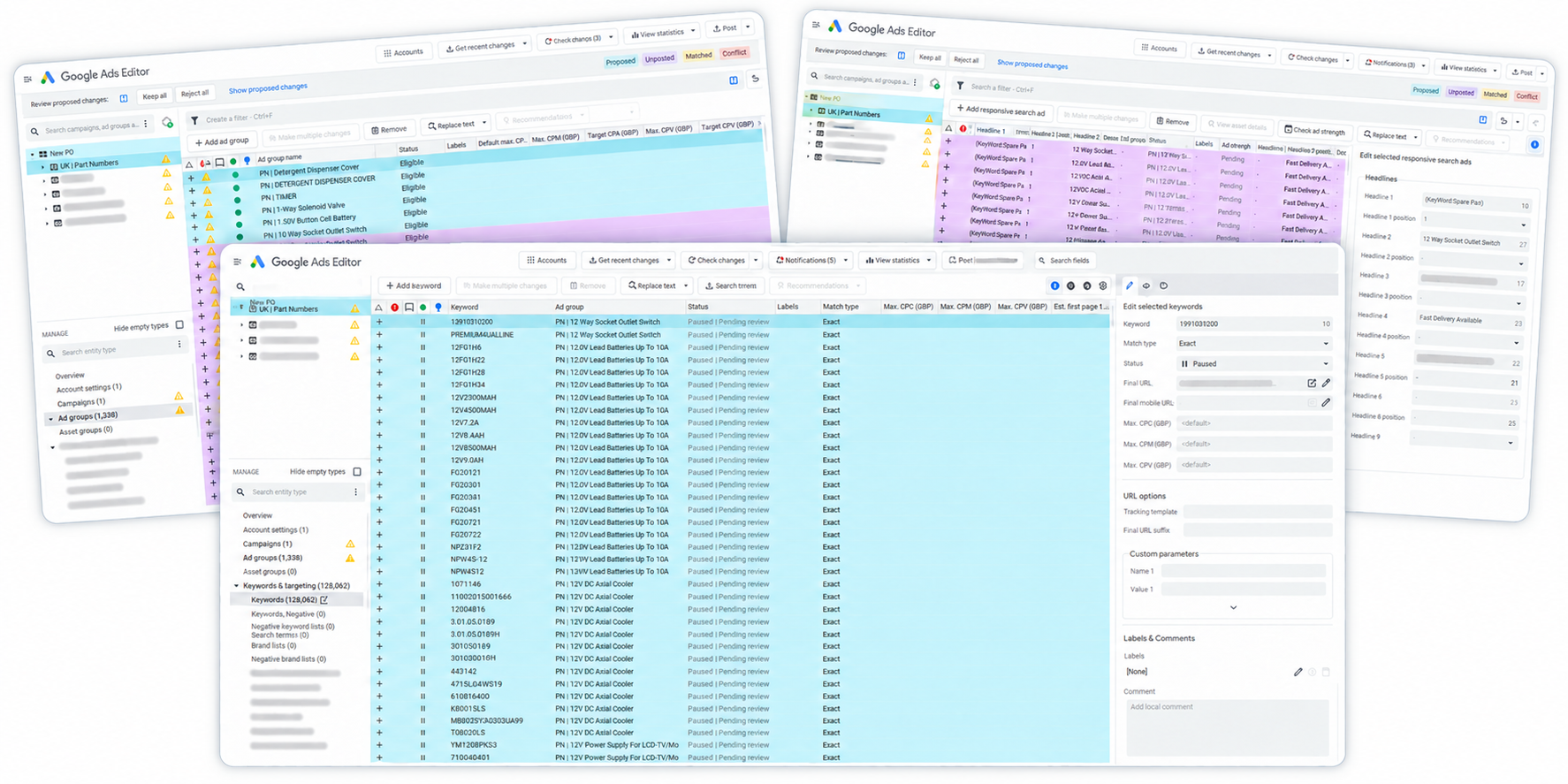
A campaign build too large for conventional production.
The product data existed, but it was not ready for Google Ads. Turning it into a consistent account manually would have created a substantial production and quality-control burden.
- Thousands of products, part numbers and destination URLs to organise.
- Campaign naming and structure had to remain consistent at scale.
- Manual production would introduce avoidable omissions and formatting errors.
- Every output still needed to be usable, reviewable and ready for specialist QA.
A repetitive manual build with an impractical review workload.
Structured campaign production from source data.
A purpose-built workflow processed the catalogue into a controlled Google Ads structure, applying the same rules across every record and preparing the complete build for expert review.
- Structured campaign hierarchy
- Consistent ad-group naming
- Exact-match keyword generation
- Product-level URL mapping
- Responsive search ad production
- Structured QA and review files
A complete account structure produced consistently and prepared for specialist review.
Weeks of expert production compressed into hours.
Multiple data sources. Multiple clients.
One central reporting view.
An agency needed to replace fragmented platform reporting with one connected environment. The resulting system gives the team a clear view across its client portfolio while preserving the detail needed to understand each individual account.
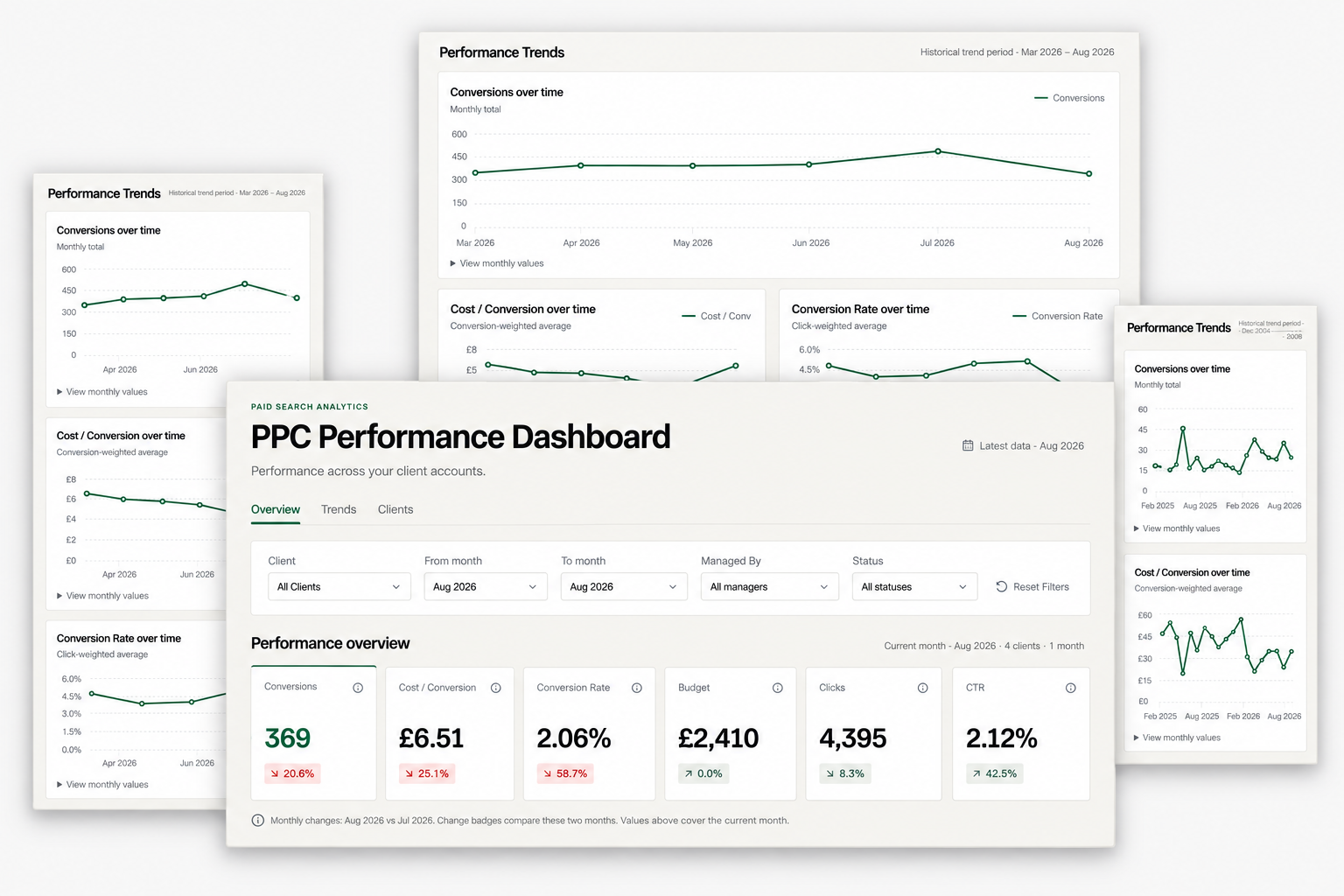
The data existed. The complete picture did not.
Performance information was distributed across platforms, accounts and reporting periods. Answering a straightforward client or portfolio question required repeated navigation, collation and interpretation.
- Client performance distributed across separate advertising accounts.
- No immediate portfolio-wide view of the agency’s paid-search activity.
- Historical trends required repeated platform navigation and comparison.
- Routine reporting questions consumed specialist time before analysis began.
Every portfolio or client question began by finding and assembling the data.
One reporting environment with two levels of visibility.
A central reporting system brought the essential performance information into one environment, allowing the agency to move from portfolio-wide oversight to individual-client analysis.
- Multi-client performance overview
- Individual-client reporting views
- Standardised performance metrics
- Flexible date-range comparison
- Historical trend analysis
- Client and manager filtering
Agency-wide visibility and client-level detail are available in the same environment.
Less time finding data. More reporting depth in one place.
Common questions about our case studies.
Clear answers about anonymity, how savings are worked out and what the figures on this page actually mean.
Many agencies prefer their internal systems and use of automation to stay private. We respect that. Client names, account details and sensitive parts of the workflow are removed while the work, process and results remain real.
Yes. The examples are based on real agency work and real workflows. Where a figure is based on an estimate rather than a directly measured result, we make that clear.
We compare the time the work took before the new system with the time it takes afterwards. For example, if a reporting process took 35 hours before and 3 hours after, the saving is 32 hours per cycle.
No. Some workflows can be timed directly before and after. Others, especially very large one-off builds, are compared against a realistic estimate of how long the same work would have taken manually. The method depends on the type of work being measured.
Not necessarily. Every agency works differently. The amount of time you can save depends on how much manual work exists now, how often the task is repeated and how suitable that workflow is for automation.
Where confidentiality allows it, yes. The site includes anonymised examples of real dashboards, AI assistants and monitoring alerts. More detail can also be discussed during an Efficiency Review where it does not expose private client information.
Find the workflows costing your agency capacity.
Map the repeated work, handoffs and manual checks consuming specialist time and identify where automation could make the biggest difference.
Repeated delivery work adds up quickly.
Three real agency systems built to remove repeated production work while keeping specialists responsible for review, judgement and final approval.
35 client reports produced every reporting cycle.
The system brings together the recurring performance data needed across 35 client accounts and prepares the reporting outputs for each cycle. The team now spends its time checking the reports, adding context and making recommendations instead of rebuilding them manually.
Manual audits took two hours per client.
The system runs the repeated checks used in the agency’s paid media audit process, gathers the findings into one consistent structure and prepares the first version of the audit. Specialists then validate the findings, add context and decide what should be recommended.
Every proposal consumed around three hours of senior time.
Approved service information, case studies, credentials and existing proposal content are organised into one reusable system. It prepares a structured first draft for each opportunity, leaving senior staff to tailor the strategy, commercial detail and final recommendation.
The same pattern appears across different parts of agency delivery.
Three more real systems built to shorten repetitive production work while keeping specialists responsible for judgement, refinement and final decisions.
Ad production was taking around two hours per client.
The system takes campaign information, offers, audience context and approved messaging and turns them into structured ad-copy outputs ready for review. Specialists then refine the messaging, choose the strongest angles and approve the final creative before anything is launched.
Initial CRO analysis took around an hour per client.
The system reviews the landing page against an agreed CRO framework covering areas such as messaging, hierarchy, friction, calls to action and conversion opportunities. It produces a structured first-pass review, leaving the specialist to decide which issues matter most and what should actually change.
Ad-to-page alignment checks took around an hour per client.
The system compares the promises, messaging, positioning and calls to action used in the ads with the landing page they send traffic to. It highlights the main gaps first, leaving the specialist to judge which mismatches are hurting the journey and decide what should be changed.
Clear numbers need a clear method.
Time savings are based on the change between the previous way of completing the work and the new system-assisted workflow. The method depends on whether the original process was directly timed or whether a realistic manual equivalent is required.
Previous workflow
We establish how long the work took before the new system was introduced, using existing delivery timings wherever they are available.
New workflow
We measure the time required after the system has taken over the repetitive production, checking or preparation work, including the specialist review that remains.
Manual equivalent
For large one-off builds where the original process was never completed manually end to end, we calculate a realistic manual equivalent based on the volume and complexity of the work.
We do not present a calculated manual equivalent as though somebody actually spent that number of hours completing the work. Where a result is based on an estimate rather than a directly timed workflow, we make that distinction clear.
Find the hours your team could get back.
We’ll look at how work moves through your agency, identify the repeated production and checking that is consuming specialist time, and show you where better systems can return that capacity.